The 5 types of wealth
An in-depth look at Sahil Bloom's book The 5 Types of Wealth and how it has impacted my life

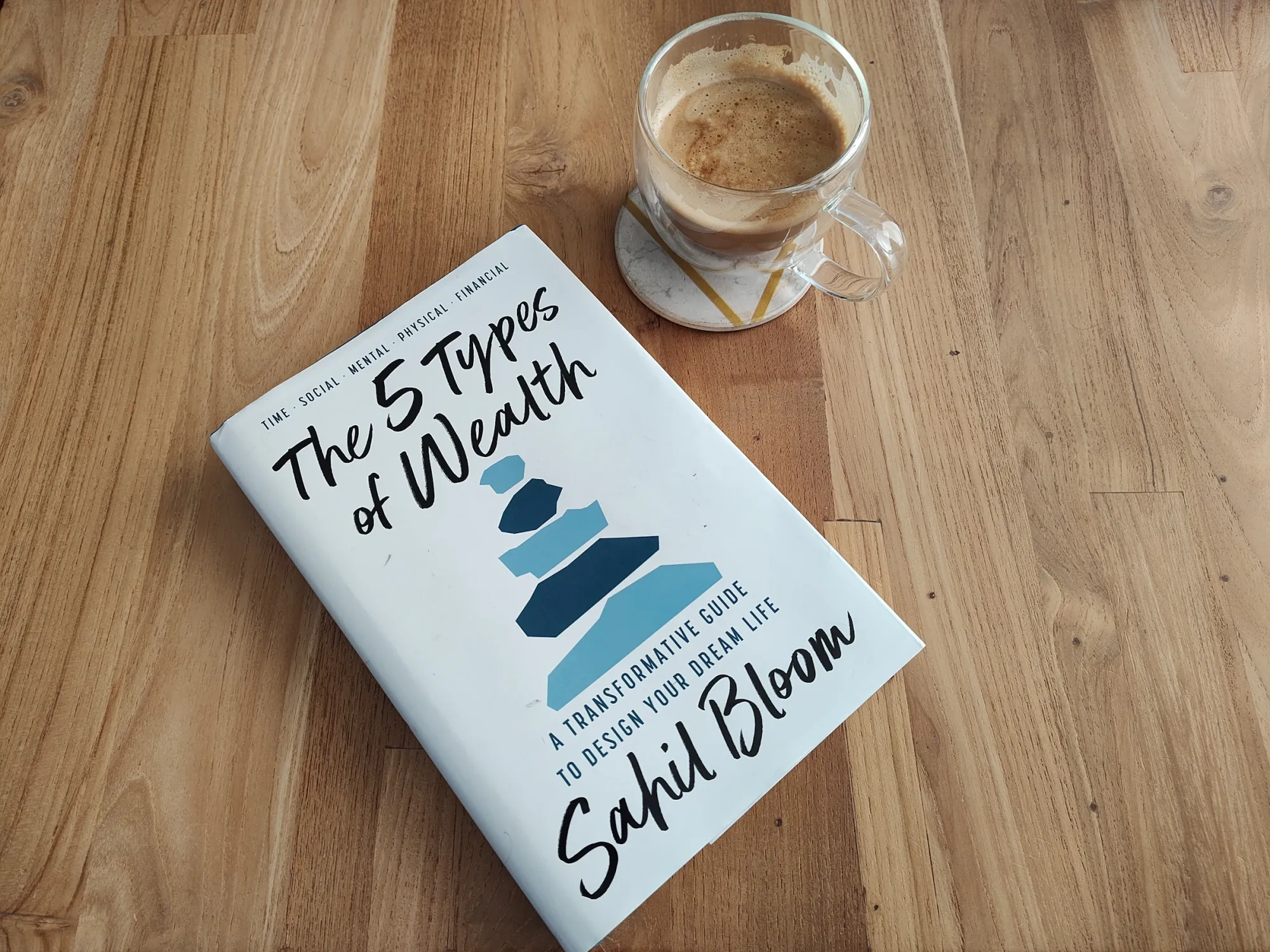
About a year ago I read The 5 Types of Wealth by Sahil Bloom. I decided to wait a bit to absorb the ideas in the book, take action, and asses the results. But first a little bit about the book itself. It is very well written and the text flows easily when reading. The four-hundred pages of content can be consumed in just a few days or a long flight. It will take a bit longer if you take the time and do the actual exercises. I highly recommend you do so as that is really where the insights come from. Many of the things in the book will be familiar. There really are no magical insights in this book when it comes to the basic content. If you are well versed in the field of financial planning, you won't gain much from the financial section. The strength of the book stems from Sahil putting all the pieces together, similar to snapping puzzle pieces into place until the entire picture of your life emerges.
The five types of wealth presented are Time Wealth, Social Wealth, Mental Wealth, Physical Wealth, and Financial Wealth. The book begins with a wealth score across all thee wealth types as a self-assessment. You should be fairly critical on this section to give yourself a proper base-line to work from. If you score perfectly on each section there is no point for you to read this book. I review this initial quiz once a year to see how I have progressed or regressed over that period and to sort out where my priorities should be going forward.
One of the most challenging sections for me followed immediately thereafter, titled the Life Razor. On a high level it seems very simple: For you particular life stage, maybe you are in your 40s like me presently, write a single concise statement that you will live by. Then whenever a choice presents itself, reflect on your Life Razor to cut away things which don't align with that statement. What makes this challenging is that you really need to reflect on things that are important presently or in the near term, and compact all of that into a brief tool that drives your everyday decision making. There are three important criteria to the Life Razor: it needs to be within your control, it should create positive second-order effects, and it should define the sort of person you are - it is a lot harder than it seems. I finally came up with one but it took several iterations for me to make it useful.
I recently used it to decline a career opportunity which seemed very tempting. I would work on cutting edge technology and the compensation would have be fantastic given that this was startup. I'm the sort of person that jumps on opportunities when they present themselves. There are only a few potentially life-changing opportunities which you will have in your life. My ambitious self always took these sort of chances and risks in the past and I have been reward handsomely. This time around though, after looking at it through my Life Razor, I decided to pass as there are now more important things in my life which have priority. It is not that I'm no longer ambitious or that I don't have goals, but that I'm no longer willing to sacrifice some things to get there - this part is covered well by Sahil in the Goals and Anti-Goals section of the book.
After a few more chapters that focus on high-leverage systems and not letting some of your skills deteriorate when they don't align with your primary objectives, the book gets to the Time Wealth section. Starring at some of the graphs which represent your life-time in weeks, or the sort of people you will be spending your time with as you age, can have a profound effect even without reading a single word. My biggest takeaway from this section was that I need to delegate more energy-draining activities in my life. I'm detailed oriented and like to be involved to understand problems and solutions in depth. Many times this leads my down a rabbit-hole which ends up being more energy draining than productive. Delegating these tasks to trusted specialist will free up a lot of my time which in turn I can use on energy-creating activities. I also found the simple 3x5 index-card to-do system very helpful: Create a list of important 3-5 tasks that you will do the next day which get you closer to your long-term goals. The key here is important tasks rather than listing all the minute things which need to get done and feeling good about checking those off. I use a note-pad rather than a 3x5 card, and I carry over important tasks which did not get completed to the next day to make sure they don't get dropped.
I enjoyed Sahil's boot-up sequence for getting into a flow-state. For me it is more of a boot-up sequence for the day: a quick work-out after getting up, a warm shower, a freshly brewed coffee, reading-time, a review of my daily to-do list, and finally a music playlist to get me through a focused initial part of the work-day. Of course there are things which may come up now and then which interrupt this process, and other things that must be done like getting your kids to school, but overall this is the routine that I strive for. My afternoon sequence is not nearly as structured as there are many professional and personal tasks competing for a finite amount of time. And while I do have a shut-down sequence for the day, it needs some tweaking and simplification, and most of all consistency on my part. Other ideas discussed in this section with I found useful because of their simplicity and applicability included the Eisenhower Matrix and how to quickly partition task priority.
Next up Sahil discusses Social Wealth, and it opens up with a great question: Who will be sitting in the front row of your funeral? This questions puts the rest of the section in perspective as those are the important people in your life, those who you should prioritize and those who will be there for you when you need them. The quality of these relationships has been shown not only to be beneficial to your mental state but also to directly impact your physical health. The rest of the sections discusses various topics to help assess and improve your relationships focusing on loneliness and decisions leading to it, the magical years with your children, and the three core pillars of social wealth: Depth, Breadth, and Earned Status. I won't go into depth on these pillars, but suffice it to say there are aspects for each where I can do better. The magical years with your kids section and with whom I should be spending time with were very helpful in sharpening my Life Razor.
I get up early to do the hard and necessary things. I prioritize family needs, personal health, hobbies, and travel above all else.
The Mental Wealth section which followed centers around what keeps you young mentally. It turns out that there are some fairly straight forward things one can do. For example stay curios like a 10 year old and don't stop pursuing hobbies. You may object that there simply is no time to do so, due to obligations one has as an adult. In which case go back to the Time Wealth section and spend some time coming up with a better plan - stay there until you make time for at least one hobby in your life on a consistent basis. For me these hobbies are: tennis and travel. I found the visualization of the Japanese concept of Ikigai very helpful in arranging my qualities and to establish the reason for my existence - once again slightly sharpening my Life Razor. Sahil also reinforces something I always found worked for me: your purpose in life does not need to be connected to your profession. Some people have a really hard time with that. These are often the same people who have a hard time separating work collogues and real friends. I'm not saying that collogues cannot become lifelong friends, but keep in mind that many of these relationship crumble much easier than true friendships when you change jobs or move across the country. The rest of this section focuses on distilling your purpose in life, learning things, and a proper create mental space - I will leave these as an exercise for the reader.
As for the Physical Wealth and Financial Health sections - I have a pretty good grasp on both. Many of the tips and ideas would have been more useful to me in my 20s than they are today, but everyone's life journey is different irrespective of age. There are a few takeaways which I did adopt. First, getting up on the weekends within an hour of my regular weekday wakeup time. For me this means 5:30am on weekdays and 6:30am on weekends. I get a quiet house for a couple hours on the weekends for reading, thinking, or just relaxing. Second, a quick workout routine after waking up just to get my blood flowing improves my motivation for the day. Third, I've made more of an effort to eat healthy, but I just can't avoid caffeine in the afternoon - I live on coffee. Tangentially related, I have found the Yuka app very handy when grocery shopping for my family. It will only be as helpful as the ingredients listed by the product manufactures, but it gives me a quick concise summary of what I'm putting into my basket by simply scanning the product barcode.
In the financial Wealth section the biggest takeaway for me was the question with which the entire section starts: What is Enough? This is much harder to answer than it may seem and requires a lot of introspective. I've always been fairly good at expense management and my investing has been well diversified - some may even say a bit too conservative. But Enough is not just about money, and more of vision of what your Enough Life may look like so that you can recognize this destination when you get there. Sahil wrote this book in 2022 just after having a newborn and describes his Enough Life with various details. Now that his son is about four years old it would be interesting to see how his Enough Life may have changed. My Enough Life has evolved with my children. The goals I envisioned have not gone away, but I needed to expand them a little as I see my children grow, and anticipate some of the challenges they may encounter along the way.
Overall this was a fantastic book and a pleasure to read. For aligning your life with the future you envision there are not many I can think of that are easier to read, comprehend, and act upon. There are several books on wealth building that I've read over the years including The Richest Man in Babylon, The Millionaire Next Door, and Rich Dad Poor Dad, just to name a few. Sahil's book is different from these - it goes much deeper into exploring the things that are really important in your life rather than focusing on wealth alone. It asks questions about the people in your life and what you envision for yourself and your family. Strongly consider adding this book to your personal library!